China Best Tempura Powder Suppliers for Global Buyers?
Choosing reliable Tempura Powder suppliers requires more than comparing prices on a marketplace. Global buyers must examine formulation, production control, documentation, and practical frying performance. A powder may look fine in a specification sheet, yet produce heavy batter, uneven coating, or excessive oil absorption in a real kitchen. Small details matter. Water temperature, mixing time, flour strength, and packaging conditions can change the final result.
Japanese culinary authority Shizuo Tsuji described tempura as “one of the most difficult Japanese dishes to prepare.” His observation remains useful for buyers evaluating commercial blends. A dependable supplier should explain how its Tempura Powder supports crispness, light texture, color stability, and consistent results across different frying systems. Product samples should be tested with vegetables, seafood, and frozen ingredients. One sample is not enough.
This guide reviews leading suppliers for international procurement, including manufacturers, private-label producers, and export-focused distributors. It considers ingredient transparency, allergen statements, certifications, batch traceability, minimum order quantities, lead times, and technical support. Reliable suppliers should provide clear test reports and respond precisely to quality questions. A polished brochure proves little. Supplier claims need verification.
There is no perfect formula. Regional taste, local regulations, and cooking equipment can expose weaknesses. Buyers should also question whether a low price reflects efficiency or reduced quality control. The strongest partnership develops through sample trials, direct communication, and documented performance. That process may feel slower. It often prevents costly mistakes.
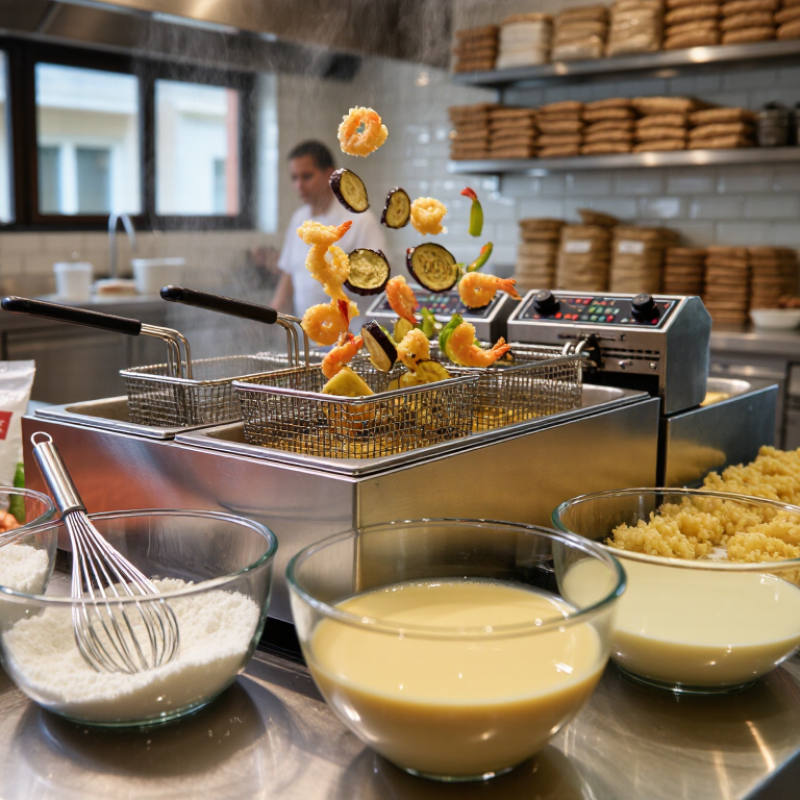
Define Tempura Powder Types: Wheat-Based, Gluten-Free, and Seasoned Blends
China Best Tempura Powder Suppliers for Global Buyers?
Tempura powder is not one standard ingredient. Its performance depends on the flour base, starch balance, seasoning, and processing control. Wheat-based powder usually creates a light, crisp shell with familiar handling properties. It suits shrimp, vegetables, mushrooms, and many foodservice applications. Gluten-free formulas may use rice, corn, potato, or tapioca ingredients. Buyers should verify allergen controls and cross-contact documentation carefully. Seasoned blends can include salt, pepper, garlic, or other spices. They reduce preparation time, but may limit menu flexibility. Taste can drift.
Experienced buyers should test each powder in real kitchen conditions, not only review a specification sheet. Mix the powder with chilled water and record viscosity, lumping, and resting time. Then fry identical pieces at a controlled temperature. Check color, oil pickup, crunch, and texture after ten minutes. A reliable supplier should provide ingredient lists, allergen statements, batch information, and consistent packaging details. Moisture protection matters during long-distance shipping. A damaged inner liner can change mixing behavior. Do not judge by appearance alone. I have found that a very crisp coating may become too hard after cooling, while a softer coating may perform better in delivery meals. The “best” type depends on the buyer’s recipe, equipment, and local taste expectations.
Set Quality Benchmarks with HACCP’s 7 Principles and ISO 22000:2018
For global tempura powder buyers, HACCP’s seven principles should define supplier quality, not decorate a certificate. Codex Alimentarius places hazard analysis, critical control points, validated limits, monitoring, corrective actions, verification, and records at the center of food safety. This matters because the World Health Organization estimates that unsafe food causes 600 million illnesses annually. A supplier should show practical controls for wheat, starch, leavening agents, allergens, foreign materials, and microbial risks.
ISO 22000:2018 adds a broader management framework around HACCP. It requires prerequisite programs, traceability, communication, risk-based thinking, and continual improvement. The ISO Survey has reported tens of thousands of ISO 22000 certifications worldwide, showing strong adoption of this standard. Buyers should request batch-level certificates of analysis, moisture results, allergen declarations, and documented metal-detector checks. A useful test is a mock recall. Can the supplier identify affected lots within hours?
Real experience often reveals gaps. A clean audit cannot replace consistent sampling at receiving, blending, and packing. Tempura powder may absorb moisture during transport, changing batter texture before its expiry date. Suppliers should monitor water activity, packaging seals, warehouse humidity, and transport conditions. Verification should include trend reviews, not isolated results. We sometimes accept paperwork too quickly. That is a mistake. Reliable sourcing requires factory visits, employee interviews, corrective-action evidence, and independent laboratory testing when risk justifies it.
Verify Compliance with the EU’s 14 Allergens and FDA 21 CFR 101
China Best Tempura Powder Suppliers for Global Buyers?
Allergen control begins with the formula, not the shipping carton. Tempura powder may contain wheat, soy, milk, or egg. Cross-contact can also occur during milling and packing. The EU requires declaration of 14 allergens under Regulation (EU) No 1169/2011, Annex II. This includes cereals containing gluten, peanuts, nuts, sesame, mustard, and sulphites above 10 mg/kg or 10 mg/L.
The United States uses FDA rules under 21 CFR 101.4(b)(2). Sesame has been a major allergen since January 1, 2023. Suppliers should provide a full ingredient statement, allergen matrix, production-flow chart, and recent batch COA. FARE’s published estimate indicates that about 33 million Americans live with food allergies, showing why small labeling errors create serious commercial risk. The 2023 FAO/WHO expert consultation also supports stronger priority-allergen controls. Documentation matters.
Tips: Request separate-line evidence, sanitation records, and change-control notices. Check whether “may contain” wording reflects verified risk or weak factory practice. Confirm translations before approval. A certificate alone is not enough. Some suppliers still overlook shared seasoning equipment. That gap deserves challenge.
Rank Chinese Suppliers by MOQ, Lead Time, Capacity, COAs, and Pricing
China Best Tempura Powder Suppliers for Global Buyers?
For global buyers, Chinese tempura powder suppliers should be ranked by practical performance, not catalog size. Tier A factories usually accept 500–1,000 kg MOQs, with lead times of 15–25 days. Their monthly capacity may exceed 300 tons. They often provide batch COAs covering moisture, microbiology, allergens, and heavy metals. Pricing commonly ranges from 1.20 to 2.80 USD per kilogram, depending on starch blends, packaging, and order volume.
Tier B suppliers may offer lower MOQs, often 100–300 kg, which helps small restaurants and test markets. Lead times can reach 20–35 days, while capacity may remain below 150 tons monthly. COAs are available, but buyers should check whether testing is factory-based or issued by an independent laboratory. Their pricing may appear attractive, although customized bags and frequent small shipments can increase the final cost. Tier C suppliers can be flexible, but their production records and documentation may be less consistent. That is a risk worth pricing in.
Tips: Request a recent COA and production sample. Compare landed cost, not only the quoted powder price. Confirm carton strength, storage temperature, and shelf life. Ask for a written lead-time promise. My practical view is imperfect: capacity figures can be overstated, and one successful sample proves little. A second batch may behave differently during frying, especially in humid kitchens. Use a small pilot order before signing a long-term supply agreement.
This anonymized benchmark compares Chinese tempura powder supplier tiers using public quotation ranges commonly seen in international food-ingredient sourcing. Scores are normalized to 100: lower MOQ, shorter lead time, stronger annual capacity, more consistent COA support, and lower indicative export pricing receive higher scores. Raw benchmark ranges: MOQ 100–2,000 kg, lead time 7–30 days, annual capacity 500–10,000 metric tons, COA availability 80–100%, and indicative pricing USD 1.45–1.90 per kg. Actual terms vary by formula, packaging, certification, season, and destination.